Showing posts with label tortoise. Show all posts

Tuesday, 13 May 2014

Highcroft Veterinary Practice Referrals Department Work Experience...gosh thats a mouthful isn't it!

August 2013

It was another full day at Highcroft Veterinary Practice working with Dr Richard Saunders. We had two guinea pigs; one in for a biopsy and one which had completely paralysed back legs, and a tortoise which had been attacked by a rat.

The guinea pig which was paralysed had been seen by more than one vet previously but due to all of the consults resulting in a recommendation to euthanize the animal, as a last ditch effort the owners brought the animal to see Richard. They owners had a lot of faith in Richard as he had previously saved another of their guinea pigs after he had also been recommended for euthanasia due to severe dental problems. As soon as we saw the animal it was clear that it had virtually no quality of life. It was trying to drag itself along using its front legs and if honest, failing miserably. Even during its time in our care, it couldn’t drag itself out of its own urine or make it to the water bottle. After tests it was decided the best thing for the guinea pig was for it to be euthanized. The owners flat out refused and said they were not willing to give up on the animal despite its quality of life being non-existent. After the owners refused to leave and we spoke to them for approx. 45minutes, Richard agreed to give the guinea pig one last course of treatment. He said that he would try an anti-inflammatory and pain killer combination and if the animal showed no improvement in a week that it would have to be euthanized. He also made it very clear that they needed to be vigilant with cleaning the animal to prevent urine scolding, and if they did not return with the animal for a follow-up, he would be informing the RSPCA as it would now be animal cruelty. The owners agreed to the treatment but said they were going on holiday and unable to bring the animal back for a follow-up. They brought the animal back about a week and a half later and saw another vet at the practice but after reading the follow-up notes it was clear the situation had worsened. The notes described bad urine scolding on the whole of the animal’s underside and another refusal to euthanize. Richard made a note on the file to call the owners to follow-up and if there was no response, to contact the RSPCA.

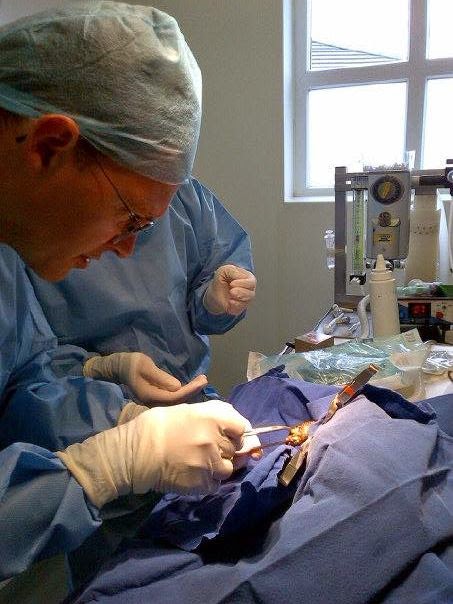
The tortoise named Rocky had come in with severe bites to his forelimbs and it was explained to us that he had been in a chicken wire pen in their garden and had been attacked by a rat. One of the legs was significantly worse than the other and after inspecting the depth of the wound, it was decided amputation was the best option.
Tortoise under sedation before amputation 
Tortoise wound before amputation
 
 
Flesh removed 
Limb after the amputation

The operation went very well and as soon as he came round Rocky was motoring around his incubator. We monitored him and placed him into a vivarium to fully recover before being discharged.

Cool new work placement

My monitor lizard Manny had been suffering from compaction and despite numerous visits to the vet, nothing had been resolved. Eventually we were referred to the vets from Bristol Zoo, who once a week take referrals at HighCroft Veterinary Practice. In October 2012, Manny was successfully operated on and made a full recovery.

So I'd been looking for a work placement for quite a long time but work placements, and even regular voluntary placements in anything animal related are pretty impossible to come by. On a wim I called HighCroft Veterinary Practice Referrals Department and just asked the question. It had only been a few months since Manny's operation and I wasn't sure if they'd even remember me. Much to my surprise, especially considering I am a Zoology student and not a vet student, they said they'd be happy to have me.

My first day was with Head Bristol Zoo Vet; Dr Michelle Burrows. Our first consultation was an African Grey Parrot who had a severe feather-plucking problem...in fact, Michelle (who specialises in birds) said it was the worst case she had EVER seen. It was quite a complicated situation with the parrot essentially being pair-bonded to a woman and hating her husband, and after a separation, the parrot ended up being solely cared for by the husband. Naturally the parrot was extremely distressed and his situation became quite uncomfortable for him. The parrot itself had caused so much damage that even when trying to x-ray him, we could barely open his wings due to the amount of dry blood. There was also a horrendous smell coming from them where it was clearly infected. He had even managed to pluck the middle of his back. After testing him for various ornithological diseases and getting negative results, and getting normal x-rays, we had to treat the infection. Michelle prescribed some treatments and provided to direction with regards to improving his husbandry, and we all hoped for the best......I am extremely pleased to say that a couple of months later I did get to see the bird again and his condition was 100 times better and still improving!

Also that day there was an emergency call about a cockatiel that flew into a window. We did an emergency consult and took the bird in for x-rays and bloods. Luckily after a few tests it was determined the bird was in generally good health and able to be released back to his owners.

The next week I was with Dr Richard Saunders. A tortoise had been brought in after not having had the best start in life, with being owned by the same lady for about 80+ years I believe but being left to her own devices in the lady's garden. Due to never being hibernated properly, the tortoise had tried to dig itself into the ground but due to being so large and the ground being so hard, most of its shell was left exposed. Despite surviving every winter after decades of acclimatisation, due to the poor conditions, the tortoise's shell was extremely damaged. More worryingly however, she was dragging her back legs. The tortoise only made it into us as in a sense it had been inherited. The lady had died in her 90s and left her possessions to a friend. Her friend had then seen the poor condition of the tortoise and decided to bring it in to be checked out.

We discovered that the tortoise had a spinal abnormality due to the way her shell had grown and it had essentially cut off the lower part of her spine and paralyzed her back legs. Having lived with the condition for so long, she had seemed to adapt quite well to pulling herself along and Richard recommended putting some lego wheels on her back end to help her move around better. She was also given a treatment plan which consisted of mostly husbandry practices to ensure that her health improved and slowly her shell repaired itself.

Having never really been a fan of veterinary work but wanting to gain more experience in the world of exotics, I was surprised at how much I enjoyed being at Highcroft. It was really interesting to see different species and everyone was so friendly.